
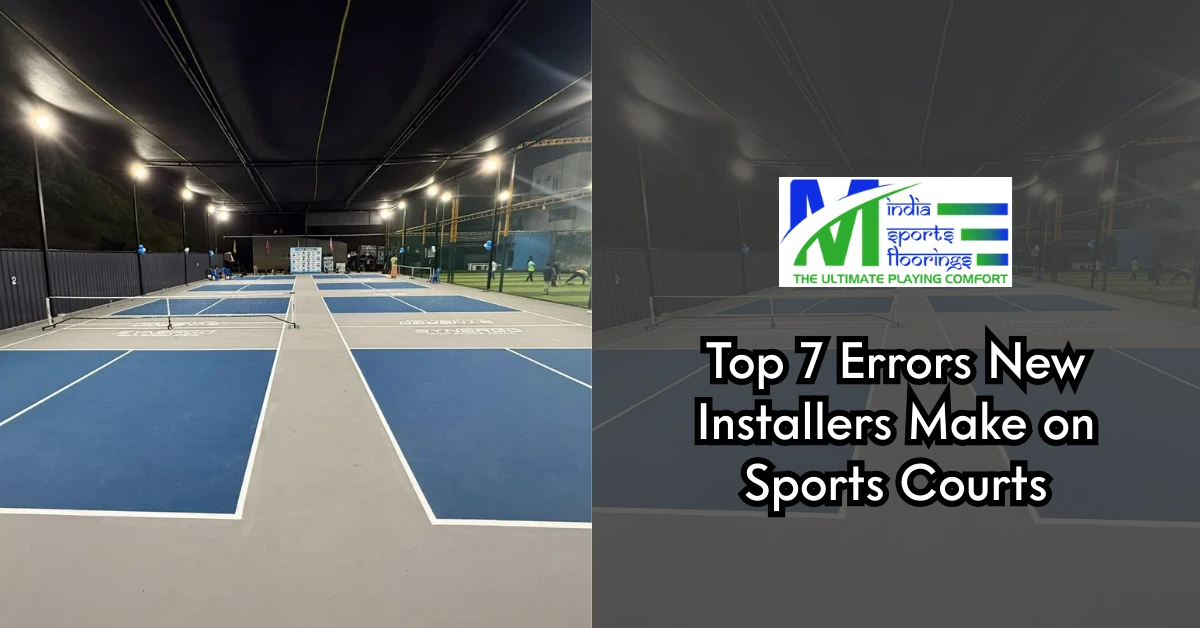
Top 7 Errors New Installers Make on Sports Courts
Table of Contents
🔥 Introduction
Sports court installation looks easy from the outside, but anyone in the industry knows — one small mistake can turn into a massive repair bill later.
Whether it’s a badminton court, basketball floor, squash court, volleyball area, or a multi-purpose indoor space, the installation phase decides how long the court will survive and how well players will perform.
New installers often rush, skip steps, or follow outdated methods. And trust me… courts don’t forgive.
So here’s a no-nonsense breakdown of the Top 7 Errors New Installers Make on Sports Courts, plus how to avoid them like an absolute pro.
1. Poor Surface Preparation (Biggest Rookie Mistake)
Surface Preparation for Sports Flooring
Most new installers underestimate one thing — prep work is 70% of the job.
Skipping proper preparation leads to:
Uneven flooring
Cracks
Loose boards
Poor bounce quality
Faster wear and tear
Professionals always:
Clean the substrate
Fix cracks and moisture pockets
Grind unevenness
Ensure perfect base smoothness
If the foundation sucks, the whole court will too. Simple.
2. Using Low-Quality Sports Flooring Materials
Choosing the Right Sports Flooring Materials
Going cheap here is a HUGE red flag.
Bad materials = bad performance.
Low-quality materials:
Peel faster
Scratch easily
Have low shock absorption
Fail safety standards
Always use trusted materials like:
Maple wood for wooden courts
Synthetic PU flooring
Vinyl sports flooring
Rubber mats
Remember: a court is an investment. Not a Jugaad job.
3. Incorrect Leveling and Slope Management
Sports Court Leveling Errors
If a court isn’t levelled perfectly, players feel it instantly.
Common leveling problems:
Ball bounce inconsistency
Player imbalance
Visible dips or humps
Water stagnation (for outdoor courts)
A well-installed court must be:
Laser-level straight
Slope-controlled (outdoors)
Shock-absorbing and even
New installers often eyeball measurements. And that never ends well.
4. Wrong Adhesives and Installation Techniques
Adhesive Issues in Sports Floor Installation
Using the wrong adhesive is like using Fevicol for building construction — it just won’t cut it.
Wrong adhesives cause:
Peeling
Surface bubbles
Hollowness under flooring
Joint separation
Pros always:
Match adhesive type to flooring
Validate supplier instructions
Control humidity during installation
Technique + material = long-lasting floor.
5. Improper Game Line Marking
Game Line Marking Mistakes
Game line marking seems simple, but it’s where many new installers mess up.
Mistakes include:
Wrong line thickness
Incorrect measurements
Uneven edges
Faded colours
Misalignment
Remember, game lines = rules of the sport.
Mess them up, and the whole game becomes a joke.
Use:
High-quality PU paints
Standard measurements
Templates for accuracy
Colour-coded lines for multi-sport courts
6. Ignoring Moisture Testing
Moisture Testing for Sports Courts
Moisture is the silent villain.
Ignoring it causes:
Wooden floor cupping
Synthetic bubbling
Adhesive failure
Fungus formation
Floor expansion
Always test:
Subfloor moisture
Air humidity
Wood moisture content
Skipping moisture tests = guaranteed future repairs.
7. Skipping Final Inspection & Quality Checks
Sports Court Quality Inspection
New installers get excited once the court “looks” done.
But a professional knows installation is incomplete without testing.
Final checks include:
Bounce test
Surface smoothness
Line accuracy
Shock absorption
Anti-skid testing
A 30-minute inspection can fix issues that turn into ₹50,000 repairs later.
🔚 Conclusion
Installing a sports court is not just a project — it’s a responsibility.
Players depend on safety, coaches depend on accuracy, and facility owners depend on durability.
Avoiding these 7 common mistakes ensures your sports court:
Performs better
Lasts longer
Requires fewer repairs
Do it right the first time, or pay for it forever. That’s the real truth.
📌 FAQs (Accordion HTML Code)
What is the most common mistake in sports court installation?
Poor surface preparation is the biggest reason sports courts fail early. If the base is not level, clean, and properly treated, the entire installation becomes unstable.
How important is moisture testing before installing a sports court?
Moisture testing is critical. Excess moisture causes wooden floors to expand, synthetic floors to bubble, and adhesives to fail. Skipping this step guarantees future repairs.
Which materials are best for badminton or indoor sports courts?
Maple wood, PVC vinyl flooring, PU synthetic flooring, and rubber sports mats are considered the most reliable materials for indoor sports flooring.
How often should game line markings be repainted?
Game lines should be repainted every 12–24 months depending on usage. High-traffic courts or schools may need repainting sooner.
Can leveling issues impact sports performance?
Absolutely. Uneven surfaces affect bounce, player balance, movement flow, and overall gameplay experience — especially in badminton and basketball courts.
Refer our other blogs here,
Expert Badminton Court Construction Company in Chennai | Quality Flooring Solutions
Badminton court flooring and consultation: ISF Founder MD- Manendra M
TT Sports Academy, Chennai- Wooden flooring Testimonial
Badminton court construction: layout and design
Badminton court wooden flooring by India Sports Floorings
Badminton court Synthetic flooring by India Sports Floorings
Your Guide to Badminton Court Flooring
Badminton wooden flooring at Chandrika Badminton Club – Trissur
VELAMMAL VIDYALAYA MULTI SPORTS FLOORING INSTALATION DONE BY INDIA SPORTS FLOORINGS
MAJESSTINE SPORTS BADMINTON WOODEN FLOORING DONE BY INDIA SPORTS FLOORINGS
BADMINTON WOODEN FLOORING DONE BY INDIA SPORTS FLOORINGS
M Manendra, MD, India Sports Floorings